Choosing a business school as a free mover is a strategic decision, and it’s one that most students make based on the wrong criteria. The city, the country, the lifestyle: these are the things that come up first in the conversation. But where you study is only one variable. The academic environment you step into, the accreditations behind it, its position in business-specific rankings, and its location relative to your career goals are what actually determine how much value you take home.
Table of Contents
Category —
Accreditations: the real quality filter
Not all business schools are held to the same standard
When you start browsing business schools abroad, everything looks impressive. Modern campuses, international brochures, promises of global careers. This is exactly why accreditations exist: they are one of the few objective filters that tell you a school actually meets international standards, not just that it is good at marketing itself.
In business education, three accreditations carry real weight: AACSB, EQUIS, and AMBA. A school that holds all three is called triple accredited. This status is rare globally, and it is not awarded lightly. It means the institution has been evaluated in depth on teaching quality, faculty competence, research output, international outlook, and its concrete relationship with the corporate world.
For free movers, this is especially relevant. Exchange students typically rely on their home university to pre-select partner institutions. As a free mover, nobody does that work for you. You are free to choose, which also means it is easy to choose wrong. Accreditations are your shortcut past the noise.
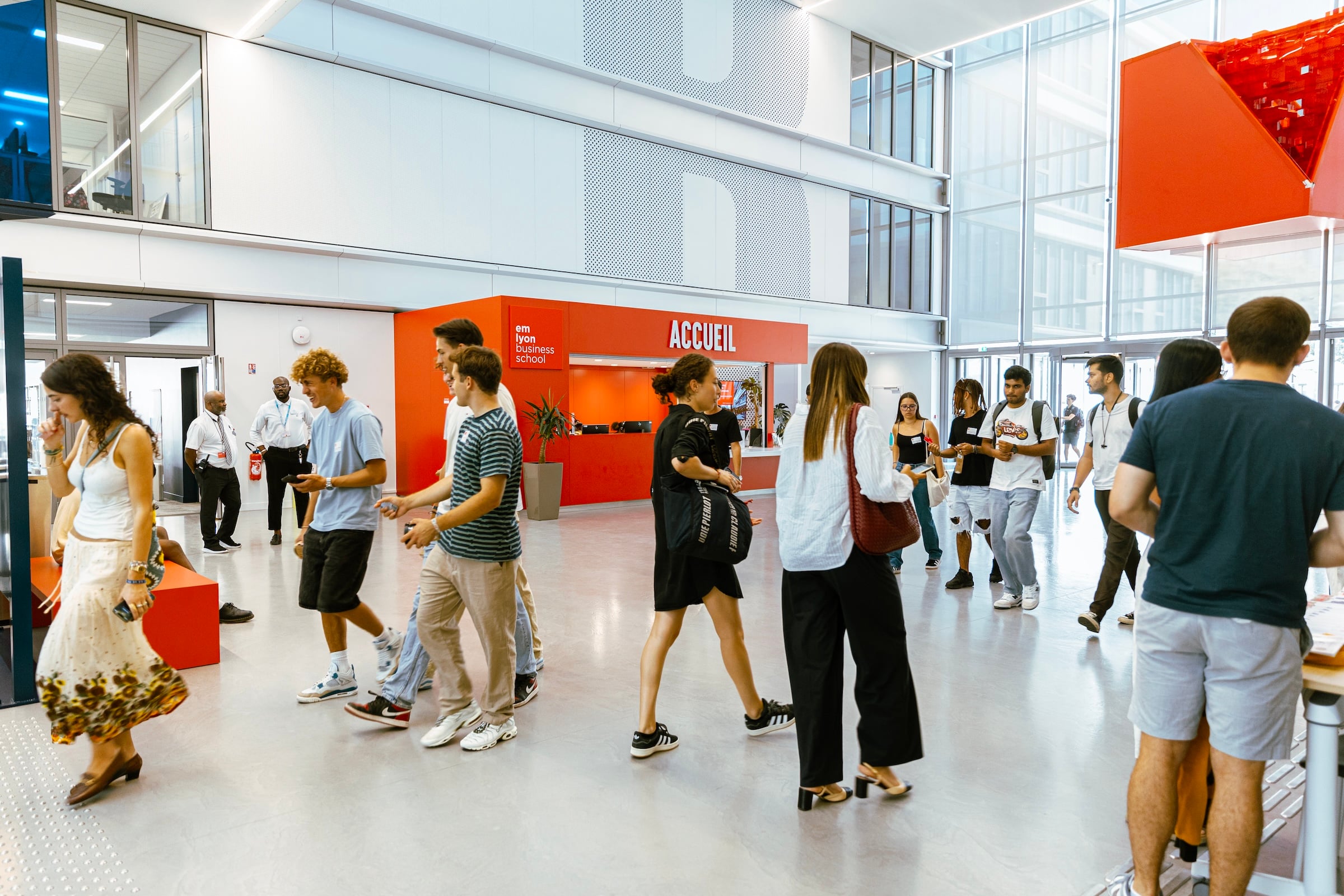
Several universities on our platform hold triple accreditation, including Rennes School of Business, emlyon Business School, EM Normandie Business School, and Paris School of Business.
Rankings: useful if you read them correctly
The right rankings for business are not the general ones
Rankings make people uncomfortable. Some treat them as gospel, others dismiss them entirely. For business education, the truth is in the middle: they are a signal, not a verdict, and the signal is only useful if you are looking at the right rankings.
General university rankings like QS World or Times Higher Education tell you little about a business program specifically. The ones that matter for business are QS Social Sciences & Management Rankings, QS Business Masters Rankings, the Financial Times rankings (covering MBA, Masters in Management, and Masters in Finance), and Eduniversal, which focuses specifically on business schools and ranks programs by field of study.
These rankings reflect how a program is perceived by employers, academics, and institutions that operate in the same international market you are preparing to enter. They are worth consulting.
One common mistake: confusing the reputation of the university with the reputation of the business school. They are not always the same. Some strong business schools sit inside universities that are not particularly famous overall. And some very famous universities host business departments that are surprisingly average.
Location as a career signal
Where a business school sits shapes the opportunities around it

Location is not just a lifestyle choice. For business students, it has a direct professional dimension.
A business school located in a major financial center, a startup hub, or a city with a strong multinational presence gives you proximity to that ecosystem. Guest lectures, networking events, company visits, and internship pipelines are all shaped by where the institution sits geographically. A top-ranked school in a secondary city may have strong academics but a weaker local corporate network than a slightly lower-ranked school in London, Paris, Amsterdam, or Barcelona.
This does not mean you should chase prestige cities blindly. It means you should match your destination to your career intent. If you want exposure to European finance, cities like London or Amsterdam make strategic sense. If you are targeting international business more broadly, a school with strong alumni networks and a genuinely diverse student body may matter more than the city itself.
Our platform includes business schools across a wide range of locations, from San Francisco to Seoul. The choice of destination is yours, but it should be a deliberate one.
The career impact of a semester at a top business school
The salary data is hard to ignore
The Financial Times rankings publish post-graduation salary data for business school graduates. The figures are consistently high, particularly for Masters in Management and Masters in Finance programs at accredited institutions. This is not accidental. Business graduates from internationally recognized schools are disproportionately entering investment banking, M&A, strategic consulting, and multinational management, fields where compensation reflects both the role and the environment.
The comparison that matters is not business graduates versus the general population. It is business graduates who invested in a high-quality international experience versus those who did not. Research on internationally mobile graduates consistently shows higher career mobility, faster progression into international roles, and stronger performance in hiring processes at global firms.
One concrete reason: many of the jobs available to business graduates are inherently international. These are roles at firms that operate across borders, require frequent travel, or involve relocating. Demonstrating that you have already navigated a foreign academic system, arranged your own mobility, performed well under pressure, and operated independently in an unfamiliar environment is direct proof that you can handle what the job actually requires.
Some of our partner universities go further. They issue additional certificates for international students who complete their semester successfully, giving you something concrete beyond the transcript to show during recruitment.
Why business specifically benefits from going abroad
The discipline only works when it is tested across cultures

Business is not a discipline you absorb passively. It works when it is discussed, challenged, and applied, and this is precisely why studying it in an international classroom makes such a difference.
International business programs are structured around interaction: case studies rather than memorization, group projects rather than individual exams, presentations that require you to defend your reasoning in front of people who think differently. You are constantly asked to explain your logic, adjust your assumptions, and communicate clearly across cultural differences.
The research on this is consistent. People who have lived and studied abroad tend to demonstrate stronger adaptability, broader strategic thinking, and a higher tolerance for ambiguity, all of which are qualities that matter in management roles. Going abroad is also a self-selection signal: it requires initiative, independence, and the willingness to operate outside your comfort zone. These are not qualities that go unnoticed.
If you are going to invest time, money, and energy into a semester abroad, the choice of institution determines how much of that investment converts into something lasting.
| Check | What to look for | Why it matters |
|---|---|---|
| Accreditations | AACSB, EQUIS and AMBA: a school holding all three is triple accredited, which is rare | An objective filter showing a school meets international standards, not just that it markets itself well |
| Rankings | The business-specific ones: QS Social Sciences & Management, QS Business Masters, the Financial Times and Eduniversal | General rankings like QS World or Times Higher Education tell you little about a business program |
| Location | A financial center, a startup hub or a city with a strong multinational presence | Guest lectures, networking, company visits and internship pipelines follow the location |
| Academic environment | Case studies, group projects and presentations in an international classroom | You are constantly asked to explain and defend your logic across cultural differences |
The right choice depends on your profile, your goals, and the semester you are targeting. If you are not sure where to start, apply early and let availability guide the conversation. The best options fill up first.
Ready to go abroad?
Start your free mover semester journey on wearefreemovers
Written by

Fabio Pellini
Co-Founder at wearefreemovers
Ready to go abroad?
Submit your application through wearefreemovers
Apply to high-quality, freemover vetted universities through one platform.
